
A rhetorical analysis essay dissects how an author or speaker uses words to influence an audience. Whether you’re analyzing a famous speech, a visual advertisement, or a written article, mastering rhetorical techniques like ethos, pathos, and logos is key to creating a compelling essay. If you’re struggling to break down these elements or need expert help, Rhetorical Analysis Essay Help services can provide the guidance you need.
What is a Rhetorical Analysis?
A rhetorical analysis focuses on how an author persuades, informs, or entertains an audience through specific strategies, such as tone, language, and structure. This type of essay doesn’t involve expressing your opinions but understanding and evaluating the effectiveness of the rhetorical techniques used.
Why Seek Rhetorical Analysis Essay Help?
1. Complexity of Rhetorical Techniques
Ethos, pathos, and logos are essential tools in rhetoric, but effectively identifying and analyzing these strategies in texts can be difficult. Professional help simplifies the process by explaining how these elements work together to persuade the audience.
2. Detailed Analysis Required
A rhetorical analysis essay demands an in-depth breakdown of each part of the text. Experts can help organize your thoughts, ensure you thoroughly cover each rhetorical element and craft a well-structured analysis.
3. Time Constraints
Writing a comprehensive rhetorical analysis often involves multiple drafts and revisions. Professional help ensures that your essay meets deadlines while maintaining high quality.
How to Write a Rhetorical Analysis Essay: Step-by-Step
Here’s a guide on how to write a rhetorical analysis essay effectively:
1. Understand the Purpose and Audience
Before you begin writing, identify the purpose of the text or speech you’re analyzing. Who is the intended audience? What is the speaker or author trying to achieve? Understanding these aspects is crucial to the analysis.
2. Break Down the Rhetorical Strategies
Analyze how the speaker or writer uses rhetorical appeals:
- Ethos (credibility): How does the author establish their authority?
- Pathos (emotional appeal): How does the work evoke emotions in the audience?
- Logos (logical appeal): What logical arguments or data are used to persuade?
3. Create an Outline
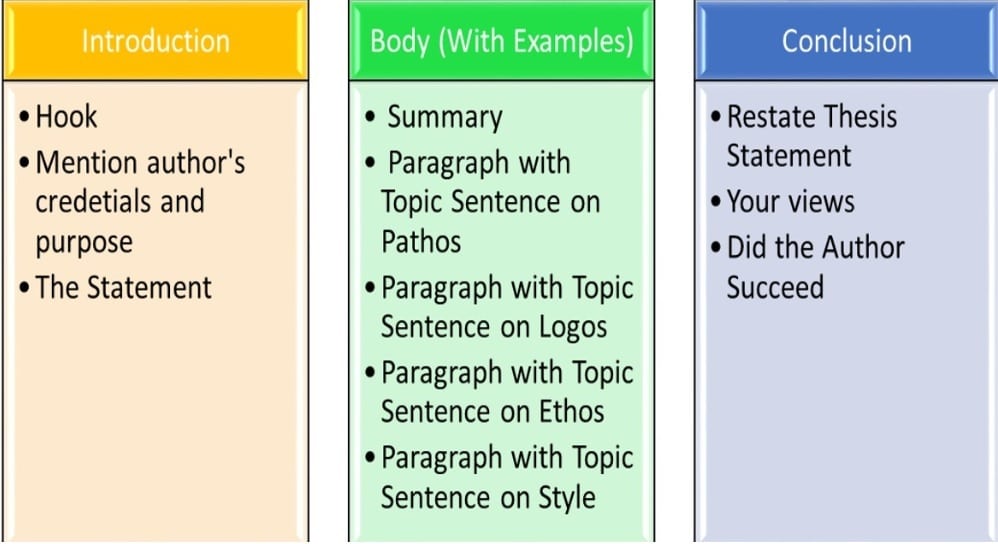
Structure your rhetorical analysis essay with a clear introduction, body, and conclusion:
- Introduction: Include the title, author, purpose, and a brief overview of the rhetorical strategies you’ll analyze.
- Body: Dedicate each paragraph to a specific rhetorical strategy or technique. Provide examples and explain how the author uses them to achieve their purpose.
- Conclusion: Summarize the overall effectiveness of the rhetorical techniques used in the text.
4. Use Textual Evidence
Always support your analysis with direct quotes or examples from the text. Explain how these examples demonstrate the rhetorical strategies you’ve identified.
Preparation
Read the piece of work to get a sense of what the author or speaker’s work is about. Look out for answers to the following questions.
- What is the writer’s main idea?
- What was the objective of the author in writing this text?
- Who is the intended audience?
- How are the ideas presented?
- How does the writer use certain writing techniques such as grammar, tone, diction, word choice?
- Are some terms deliberately repeated?
- Is punctuation used to create a specific effect? For example, the use of italics, underlining, bold, different font types, styles, and colors?
When taking an AP exam, you are time-bound. Therefore, you do not have abundant time to read the work repeatedly.
Take notes regarding the questions above the first time you peruse the work.
Those notes will make it significantly easier to analyze, just like a persuasive essay introduction or how to write a literary analysis essay.
When writing a rhetoric essay, you must consider elements such as the speaker, the occasion, the audience to which the piece was intended, and the purpose.
Moreover, you have to consider the subject and the tone. Speaker refers to the author or creator of the non-fiction work you will analyze.
Identify the author’s name or initials that give him/her the authority to write on the subject. If the narrator and the writer are different, note down both.
Occasion refers to the type of content and its context. For instance, you can easily pick out the difference between a research paper and a memo.
The audience is the primary target audience for whom the content is created. Depending on the target audience, the writer will use different writing techniques.
For instance, a book written for students about a specific topic will be simplified, while a professional or academic paper may use technical language and present numerous facts.
Purpose refers to the main idea or theme of the paper, while subject simply refers to the topic or essay.
Rhetorical Analysis Essay Outline
The following is a general outline of a rhetorical analysis essay although it may differ slightly depending on the work being analyzed.
If writing a rhetoric essay as part of your AP Exam, use the outline your professor provided.
Introduction
The introduction should state the document’s title, essay, or work you will analyze.
State the rhetorical situation you will be analyzing, the author of the rhetoric, the intended audience, and the context of the work you will be writing about. This background information should be to the point and concise.
Thesis
The thesis is usually written as part of the introduction. It can be the last paragraph of the introduction or the last few sentences of the last section.
Note that this is not the thesis statement for the text or work you will be analyzed; rather, it is a statement of the main objective of your rhetoric analysis.
It should give the reader a sense of what to expect in your essay.
Tools
This section of your essay should highlight the specifics of the various tools the author of the rhetoric uses to achieve a certain objective.
This is the section where you cover tone, language, diction, tenses, and other writing tools.
Body
In the body, expound on the various tools and techniques that the rhetorician uses.
Give examples of each tool and explain how they have been used to achieve a specific objective.
Justify why the author uses a specific strategy and whether it is effective regarding the audience, occasion, and purpose.
Persuasion Appeals
When analyzing the text, it is essential to look at the author’s techniques to influence the reader.
There are three main persuasion appeals: Pathos, Ethos, and Logos. Pathos refers to emotionally persuading the reader, logos appeals to logic, and ethos is the persuasion based on credibility.
Different writing tools are used for each persuasion mode. For instance, if the author has given his credentials, it establishes his credibility to talk about the subject.
Therefore appealing to the readers’ ethos. Similarly, the logical presentation of ideas influences the audience’s interpretation of the work.
Techniques such as using descriptive language appeal to the reader’s pathos.
Conclusion
Your conclusion should dwell on your overall argument. Give an overview of the text’s strengths and weaknesses and overall evidence for the text’s effectiveness or ineffectiveness in accomplishing the specific goal.
Strategies and Tips for a Good Essay: Grammar, Vocabulary, Using Present Tense, Word Count, and More
Various basic guidelines apply to all essays regarding grammar, using tenses, tone, and coherence. Below are the overall guidelines for writing a rhetorical essay analysis.
Vocabulary – Use a variety of vocabulary. Replace commonly used verbs with their appropriate synonyms. Avoid overusing certain words unless you use repetition to deliberately bring out a certain effect, such as for emphasis.
Length
The length of your essay will vary depending on the text you are analyzing and the specific thesis statement.
However, rhetoric essays for the AP exam are 500-700 words. Your lecturer may give specific instructions on word count – adhere to them.
Grammar
Grammar may sound obvious, yet often overlooked. The reality is your professor will penalize you for work that has grammatical and punctuation errors.
Proofreading and Editing
Before submitting your essay, proofread it thoroughly. Check it to ensure a variety of sentence schemes and types; punctuation marks are well used, coherence, and proper spelling.
Ensure you have not used any abbreviations in your essay.
Numerous applications are available online to help you check for grammatical errors and detect plagiarism in your essay.
The recommended tense for rhetoric essays is present tense. Although you may need to use the past tense, your observations should be current.
Pronouns
Since a rhetoric essay aims to present an objective tone, you should write in the third. Avoid using the first-person pronoun “I.”
Using the first-person pronoun might give an impression that you are giving your personal opinions, yet this is a fact-based type of essay.
Coherence
Use a writing style and select words that create a seamless essay flow.
Use various transition words appropriately to transition from one idea to another.
Ensure that the ideas flow logically. This prevents you from jumping from one idea to a completely different one within the same paragraph.
Use the appropriate punctuation marks to ensure your essay is readable.
Analyze
Remember that a rhetoric essay is not just about identifying rhetoric strategies and techniques.
You will need to demonstrate the effectiveness of those strategies versus your thesis statement.
Essay Organization
Ensure your essay has a suitable title. The title should explain the theme statement and the text being analyzed.
Keep the title short and catchy. Use subtitles to categorize your work. This will help you present your arguments better while improving the readability of your essay.
Tips for Writing a Rhetorical Analysis Essay Introduction
- State the purpose of the rhetorical analysis. Doing so lets the reader know what exactly to expect.
- Do not outright state, “This is a rhetorical analysis essay.” Instead, weave in information in the introduction that will help the reader naturally derive that the paper is a rhetorical analysis. You can check an example rhetorical analysis essay using ethos, pathos, and logos.
- Key information in the introduction segment includes the name/names/initials of the writer, the name of the text being analyzed, the objective of the analysis, the target audience, and a brief highlight of SOAPSTone.
- Give a summary of the key rhetorical techniques employed in the text and show how they work towards achieving the desired purpose of the text.
- Consider making an original argument about the text and its thesis statement.
Tips for Writing the Body Paragraphs of a Rhetoric Essay
The body is the main part of a rhetorical analysis essay. It contains all the essential details of your analysis. The main purpose of the body is to answer the following questions:
- What is the strategy that the author has used?
- Has the strategy achieved the intended purpose?
- What are some of the examples of the strategy being utilized?
- How did the various tools and techniques influence the fulfillment of the strategy?
- What persuasion appeal has the writer used?
You can adopt multiple strategies to organize the paragraphs in your rhetoric essay body section.
First is organizing the paragraphs according to the appeals.
Depending on the content for each persuasion mode, you can write a paragraph or as many as you need to clarify each.
The order in which you arrange the appeals does not matter. Identify at least one claim for each mode and evaluate it by deriving examples from the text.
The last paragraph should evaluate the overall impact of the three appeals.
The second alternative for organizing your body is arranging the strategies chronologically.
Start from the beginning of the text, identifying how the various appeals and styles have been used. Work your way to the end of the text.
This approach ensures that every paragraph begins with a topic sentence.
Each sentence in each paragraph should further expound the topic sentence. You should not jump from one topic to another within a section.
The third option is to analyze the content in four broad categories: diction, syntax, punctuation, and tone.
Diction refers to the choice of words that the writer uses to convey a particular meaning.
Look out for specific words and phrases used words that have been used repetitiously, whether or not the author has used filler words. For instance, repetition can be used to create emphasis.
The appropriate diction varies with the purpose, occasion, subject, and target audience. The technical text requires the use of field-specific vocabulary.
Concerning the purpose of the content, consider whether the writer intended to entertain, inform, or persuade and whether the words used had the intended impact.
For instance, if the author intended to inform, the diction will most likely be straightforward.
On the other hand, if the intention was to entertain, the writer may have used some playful words.
Formal diction is the standard for scholarly writing and text, but you may encounter slang or colloquial for informal texts.
Syntax refers to word arrangement within a sentence. The standard scheme for arranging words with a sentence is subject-verb-object.
However, the writer may deviate from this scheme to add emphasis. Another critical aspect regarding syntax is sentence length.
Long sentences provide details and descriptions, while short sentences bring the main idea straightforwardly.
The use of a variety of sentence lengths often characterizes good writing.
Sentence types range from simple, declarative, exclamative, compound, complex, compound-complex, interrogative, and imperative sentences.
Identify the type of sentences the writer has used and to what impact.
Appropriate use of punctuation marks is vital for any good writing. Be sure to check how often punctuation marks such as semicolon, colon, dash, period, and others have been used.
Finally, the tone brings out the writer’s attitude about the subject.
Tone is a unique rhetorical strategy that is brought out by the use of other rhetorical strategies.
A writer can bring out the tone in three major ways. The first combines Diction and Tropes, the second combines syntax and schemes, and the third is whether the writing is detailed or lacks details.
General Guidelines for Writing the Body Paragraphs of a Rhetoric Essay
- Whichever approach you use to present your work, ensure you provide enough information to support your thesis.
- Directly quote and paraphrase the necessary information. Do not give your opinions or rely on your emotions to justify your objectives.
- Maintain an objective tone in your essay. Do not use first-person pronouns. Ideally, stick with the third person.
- Remember to observe grammatical rules such as varying sentence lengths and diction.
- Cite your work accordingly.
- Ensure a smooth transition between sentences and paragraphs and from one rhetoric strategy to another.
- Once done with the entire essay, proofread your work for grammar, smooth transitions, fluidity, and logical argument.
- Avoid using words such as good or bad when describing the efficacy of a rhetorical strategy in achieving a given objective. Instead, use the words “effective” or “ineffective.”
Tips for Writing an Effective Conclusion to a Rhetorical Essay
A conclusion in any writing allows you to create a memorable impression on the reader. It is your chance to leave the readers with a sense of completeness. While the introduction familiarizes the reader with the content discussed throughout the text, the conclusion summarizes the ideas discussed in the essay.
Tips for Writing an Effective Conclusion to a Rhetorical Essay
- Restate your thesis. Paraphrase the objective of your essay.
- Incorporate a conclusive statement on whether the author achieved the specific objective that your essay was analyzing. Back it up with a sentence or two to show that, indeed, the author achieved the said objective.
- Avoid summarizing concepts discussed in the main text (the essay’s body). The reader has already read that in the body.
- If there is any rhetoric question you asked in the introduction part of the essay, give a conclusive answer to the question in the conclusion segment
Popular Rhetoric Analysis Topics
Choosing a good rhetoric essay topic is key to writing a good rhetoric essay. However, you may find yourself confused about which topic to choose.
Consider these two guidelines. First, go for a topic that interests you or you are familiar with.
Secondly, ensure that the topic you choose will interest your readers.
Your analysis can be in text, speech, poem, commercial, or any other subject of interest, provided it is not fiction.
You can analyze topics on various subjects, such as culture and emerging issues.
When analyzing a piece of literature, you could be asked to describe the narrative voice, examine the literal context, describe the mood of the work, and discuss characters, among others.
That said, below is a list of 20 popular rhetoric analysis topics you can choose from.
- Donald Trump’s 2016 inauguration speech
- Martin Luther King’s “I Have a Dream” speech
- John F. Kennedy’s inauguration speech
- Steve Jobs’ commencement speech
- Rhetorical Analysis of a Movie Trailer “Prisoners” 2013
- Rhetorical Analysis of the Geico Camel Hump Day Advertisement
- Rhetorical Analysis of Richard Estrada’s Article
- Rhetorical Analysis Essay: We Are Marshall Speech
- Shakespeare’s play “Hamlet”
- Edgar Allan Poe’s short story “The Tell-Tale Heart.”
- Harper Lee’s Novel “To Kill a Mockingbird”
- Rhetorical Analysis of “Anti-Intellectualism: Why We Hate the Smart Kids”
- Rhetorical Analysis Essay on “Horatio Alger” By Harlon L. Dalton
- Tattoos as an expression of freedom
- School uniforms are a necessity in the education system.
- Consequences of obesity among individuals and society as depicted in the 2018 WHO report
- Rhetorical Analysis Paper “The Story of an Hour“
- Rhetorical analysis of the article The Big Tilt: Participatory Inequality in America by Sidney Verba, Kay Lehman Schlozman, and Henry E. Brady
- Examine the setting of a novel of your choice.
- Analyze a speech that you once listened to and greatly impacted you.
- Provide a rhetorical analysis of any of Shakespeare’s books
- Analyze the “Brave Heart” speech by William Wallace
- Richard Nixon’s resignation speech
- Jonathan Edwards’ sermon “Sinners in the Hands of an Angry God.”
- The “Wild Nights” poem by Emily Dickinson
- A speech by a Nobel Prize winner of your choice
- Rhetorical Analysis of the movie ‘American History X‘
- A Perfect Christmas – Walgreens revisits the Town of Perfect Commercial
- Rhetorical analysis of “A Homemade Education” by Malcolm X
- Rhetorical Analysis of a Photo “The Flame Arrives At City Hall”
- Rhetorical analysis of the article The Big Tilt: Participatory Inequality in America by Sidney Verba, Kay Lehman Schlozman, and Henry E. Brady
- Rhetorical Analysis of the Declaration of Independence by Jefferson
- Rhetorical Analysis of Malala Yousafzai’s speech to the UN
Comparison between Rhetoric Analyses of a Text versus Rhetoric Analysis of a Commercial
Essentially, the principles for writing a rhetorical analysis for a commercial are similar to that of text.
Like in the text, you will identify the target audience, subject matter, and rhetoric strategies used.
You will also identify the appeals and presentation in the commercial.
Unique to rhetorical analysis of a commercial, you must identify the characters used.
Are the characters celebrities? How do they carry themselves? What role do they play in the commercial?
Also, identify the setting of the commercial and its relevance in bringing out the purpose of the commercial.
Analyze the use of language in the commercial and its usage to persuade or bring out the commercial’s message.
The outline and general guidelines for writing a rhetorical analysis of a text and a rhetorical analysis of a commercial are the same.
While this article has done its best to offer you tips and strategies for writing a good rhetorical essay, the process can be complicated and confusing.
It may require you to commit extensive time to practice writing such essays to be able to write an A grade piece.
Since you may not have the time to dedicate to growing your writing skills, our professional writers can help you write an A-grade rhetorical analysis essay.
At Write My Paper 4 Me, We offer “Do my rhetorical analysis essay” services at an affordable price.
Whatever your rhetorical analysis essay topic, we will do an excellent job if you are considering buying a college term paper.
To understand the quality of our work, look at our rhetorical analysis essay example.
FAQs
What types of texts can I analyze rhetorically?
You can analyze speeches, essays, advertisements, poems, and even visual elements like commercials or political cartoons.
How do I analyze ethos in a text?
Focus on how the author establishes credibility or authority. This could be through their expertise, reputation, or ethical appeal to the audience.
What is the best structure for a rhetorical analysis essay?
A well-organized rhetorical analysis should include an introduction, paragraphs analyzing different strategies, and a conclusion summarizing the techniques’ effectiveness.
How can I improve my rhetorical analysis?
Focus on providing detailed examples and explaining the purpose behind each rhetorical strategy. Avoid summarizing the text; dive deep into how the strategies persuade the audience.
Conclusion
Writing a rhetorical analysis essay requires an understanding of rhetorical strategies and the ability to evaluate their effectiveness critically. You can produce a compelling analysis that breaks down complex texts with the right approach. Suppose you’re feeling overwhelmed or pressed for time. In that case, professional Rhetorical Analysis Essay Help can guide you through each step of the writing process, ensuring a high-quality essay that meets academic standards.