
The methods section of a research paper is where you explain the procedures and techniques used to conduct your research. Whether you’re conducting a survey, experiment, or qualitative study, this section provides transparency, allowing others to replicate or understand your research process. Writing this section clearly and concisely is crucial to showcasing the reliability and validity of your work.
What is the Methods Section in Research?
The methods section outlines the research design, data collection methods, tools, and analysis techniques. It provides the “how” of your research, ensuring readers understand the steps you took to gather and analyze data.
Steps for Writing an Effective Methods Section
1. Define Your Research Approach
Start by defining whether your study was qualitative, quantitative, or mixed-methods. Explain why this approach was best suited for your research question. For example, did you use a quantitative method to analyze measurable data, or was your research more focused on exploring human behavior through interviews?
2. Describe Data Collection Methods
Detail how you collected your data. Whether through surveys, experiments, focus groups, or interviews, it’s important to explain your data collection’s setting, participants, tools, and timeline.
- For Quantitative Methods: Explain your sampling process, variables measured, and tools used, such as surveys or statistical software.
- For Qualitative Methods: Discuss the participant selection, interview format, or observational methods used.
Example:
We surveyed 300 participants using a Likert scale to measure customer satisfaction. Data were collected online through an anonymous survey platform over two weeks.
Qualitative vs. Quantitative Research Methods
Qualitative Research
- It focuses on understanding human behavior, social interactions, and cultural phenomena.
- Data collection involves interviews, participant observation, and case studies.
- Example: Semi-structured interviews were conducted with ten community leaders to explore their views on public health initiatives.
Quantitative Research
- Involves the collection and analysis of numerical data.
- Methods include experiments, surveys, and statistical tests.
- Example: We used regression analysis to evaluate the correlation between advertising spend and customer engagement.
3. Outline Your Data Analysis Process
Once you’ve explained how data was collected, the next step is to describe how it was analyzed:
- For Quantitative Studies: Include details on the statistical tests you performed, the software used, and how variables were measured.
- For Qualitative Studies: Explain how you coded your data, identified patterns, or conducted thematic analysis.
4. Address Ethical Considerations
Ethical considerations play a significant role in many studies, mainly when dealing with human subjects. Include information about consent forms, privacy measures, and any ethics board approval your research received.
Common Mistakes to Avoid
- Lack of Detail: Ensure that every step of your research is detailed so that another researcher can replicate your study.
- Confusing Terminology: Use clear and straightforward language to explain technical terms or complex methodologies.
- Missing Justifications: Always justify why a particular method was used and why it was appropriate for your research.
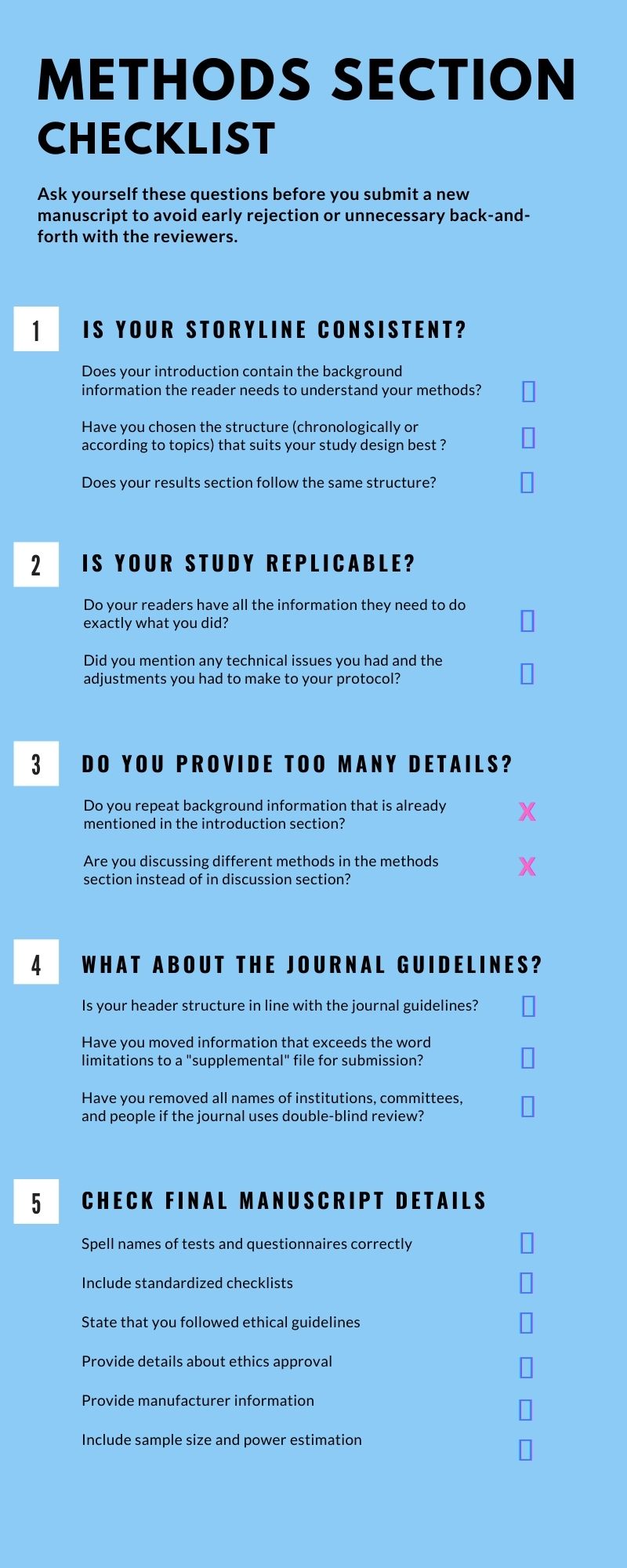
How to Write an APA Methods Section
The methods section should include the following:
- The type of research
- How data was collected
- How the data was analyzed
- Tools or materials used in the research
- Your basis for selecting the methods
Learning how to write the methods section in the APA formatting style is essential. This method part has a descriptive nature, which makes it seem more manageable. Still, it is also a section where the details are usually missed when writing and while reading because of its highly procedural nature.
Step 1: Create Your Methodological Approach
Start by introducing your overall approach to the research, which should be qualitative or quantitative. Then restate your research problem; which research question did you investigate?
Depending on the field and the method, you can start with an argument about the authentication and the rules supporting your methodology.
Briefly discuss why you choose the approach to answer your research question. Is the approach a standard methodology, or does it need an explanation? Were there any ethical reflections?
Are there any principles for validity and dependability in your chosen research method?
When discussing the methodological approach in a qualitative study, it aims to create background knowledge about the actions and social organizations and share the beliefs of a specific group of people.
This approach is significant, especially when assessing people’s views or understanding of a precise question. This approach is less controlled and more explanatory. This means that you must reflect on your place as a researcher, considering how your subjects and insight might impact the findings.
When discussing a quantitative approach, aim to come up with generalizable facts about the foundation of an event.
You can use a quantitative approach when you want to research and file measurable social trends or evaluate the effects of a specific procedure on various variables.
Additionally, you can combine the two approaches. For example, you might focus mainly on a quantifiable social trend and, conversely, interview people to get their ideas on how the pattern impacts their lives.
Step 2: Describe How You Collected Data
After creating and introducing your general methodological approach, give details on how you collected or generated data. This part of your methods section tells the readers how, when, and where you conducted your research.
It also allows you to show which limitations were established to guarantee your findings’ relative independence.
There are various types of research methodologies;
- Observation
- Experiments
- Surveys
- Focus groups
- Interviews
- Secondary data analysis
- Mixed methods
The following is a guide on how to describe your methods in the two approaches;
Qualitative Methods
This method requires you to explain the principles you used to choose the participants, the background of the research, and the part you played when gathering the data.
1. Overview
Utilize subheadings to divide the various subsections you want to discuss, such as the participants, materials, design, and procedure.
2. Interviews
- How and when were the interviews conducted?
- How did you find and pick the participants?
- What form were the interviews (structured, unstructured, or semi-structured)?
- What were the lengths of the interviews, and how were they recorded?
3. Participant Observation
- What group of people did you observe, and how did you gain access to them?
- What was the length of your research, and where was its location?
- What was your role in the community?
- What method did you use to record data?
4. Present the Data
Explain why you choose the research study for the focus of your analysis. Don’t forget to cite the materials and methods you used to collect and select them.
Quantitative Methods
Here, you should give enough details to allow another researcher to replicate your research.
Describe how you measured your variables and operationalized the theories. Also, include your selection methods, tools, procedures, and the materials you used to collect data.
1. Survey
- Give details about how the study or the survey was conducted. Describe how you designed the research question and the form that the question took. Were they in multiple choices, open-ended, or closed?
- What selection methods did you use to pick your subjects?
- What were the means of the surveys? Were they by phone, online, by mail, or in person?
- What were the size of the sample and the reaction rate?
2. Experiments
This is the part where you are supposed to give the details of the tools, techniques, and procedures you used to do the research. Ensure you provide sufficient detail to allow other researchers to replicate your study. Describe how you recruited the participants, designed the experiment, and handled and measured the variables.
3. Existing Data
Give details on how you collected and selected materials for your results. Explain how the data was generated and the criteria you used to choose the materials.
Step 3: Evaluate and Justify Your Methodological Choices
You must make a case for why you chose the particular methods for your research. Provide a background for unconventional methods you used for your topic.
Explain why you didn’t use other methods and show that the chosen approach adds new knowledge or understanding. Recognize the limitations and weaknesses of the method you chose, and remember to justify why the approach’s strengths outweighed them.
Things to Remember When Writing the Methods Section
I. Pay Attention to Your Objective and The Research Question
The methods section must clearly describe why your methods match your objectives and persuade the readers that you picked the best approach to address the research question and the problem report.
II. Use Past Tense
Always use past tense to describe your methodology. By the time you write the report, you have already finished writing your research, so use past tense to record what you did.
III. Mention Relevant Sources
Strengthen your methodology by referencing current research in the field to confirm that you adhered to the established practices for this type of research. Show that you took a new methodological approach to address the gap in the works. Limit your references to within 5 to 10 years unless you use old sources.
IV. Include a Visual Presentation
A visual presentation helps the readers follow the methodology well. Visual presentations like flowcharts, tables, and schematic diagrams can be used in this section. The visual presentations will help you break the boredom and streamline the absorption of compound data.
V. Be Descriptive
Ensure you give sufficient details that other researchers can use to replicate your study. Avoid including irrelevant information that is not significant to the results of the experiments. The methodology should be clear and well-structured to make an argument for your approach.
VI. Specify the Variables
Mention all the control variables, dependent variables, and independent variables. Also, mention any extraneous variables that might have an impact on the findings of the study.
VII. Use Proper Style
When writing an APA methods section, ensure that you place only relevant information that will be used in the conclusion. Avoid complicated and fused sentences by using active voice. Use the proper APA style when referencing all sources mentioned, and always keep a style guide by your side when using the APA style.
VIII. Indicate the Ethical Approvals
Initially, in the methods segment, mention if your research was permitted by the ethics board or official appraisal board or if you have a written cognizant agreement from patients or the custodians.
IX. Proofread
Before submitting or publishing your research paper, make sure that you check it for grammar, spelling, and punctuation mistakes. Spell checkers can be handy when you want to proofread, but you can recognize some errors. Sometimes, you can get too close-tied to your work and find it hard to spot errors. In that case, the best thing to do is to get a second opinion about your paper.
Conclusion
The method section is essentially one of the most vital parts of your research paper. It gives vital information that enables the reader to determine the rationality of the findings and the report’s conclusion.
You should provide a clear and accurate explanation of how the research was conducted and the basis for the methodological approaches you selected.
Keep in mind the instruction of your supervisor. Every field and supervisor has specific requirements that you must follow while writing down your methods section.
Writing a research paper can make you feel overwhelmed. It is time-consuming, and the topic can be tough. The good news is that you can get your research paper done.
FAQs
What should be included in the methods section of a research paper?
Include a detailed explanation of the research design, data collection methods, analysis techniques, and any tools or software used.
How do you write a qualitative methods section?
Focus on the rationale behind participant selection, data collection methods (e.g., interviews or observations), and how the data was analyzed (e.g., coding or thematic analysis).
Why is the methods section important in research?
The methods section provides transparency and allows other researchers to replicate your study or build upon your work.
Conclusion
Writing a clear and well-structured methods section is essential for any research paper. This section outlines the backbone of your research, from data collection to analysis. By following these guidelines and addressing common pitfalls, you ensure that your research is credible and reproducible.
At DoMyPapernow, we offer top-quality, well-written research papers for every field. Please give us your work and complete your paper before the deadline.
Tips for Writing an Opinion Piece
Beginner’s Guide for Writing a Visual Analysis
Do My Paper Now Instant Essay Generator